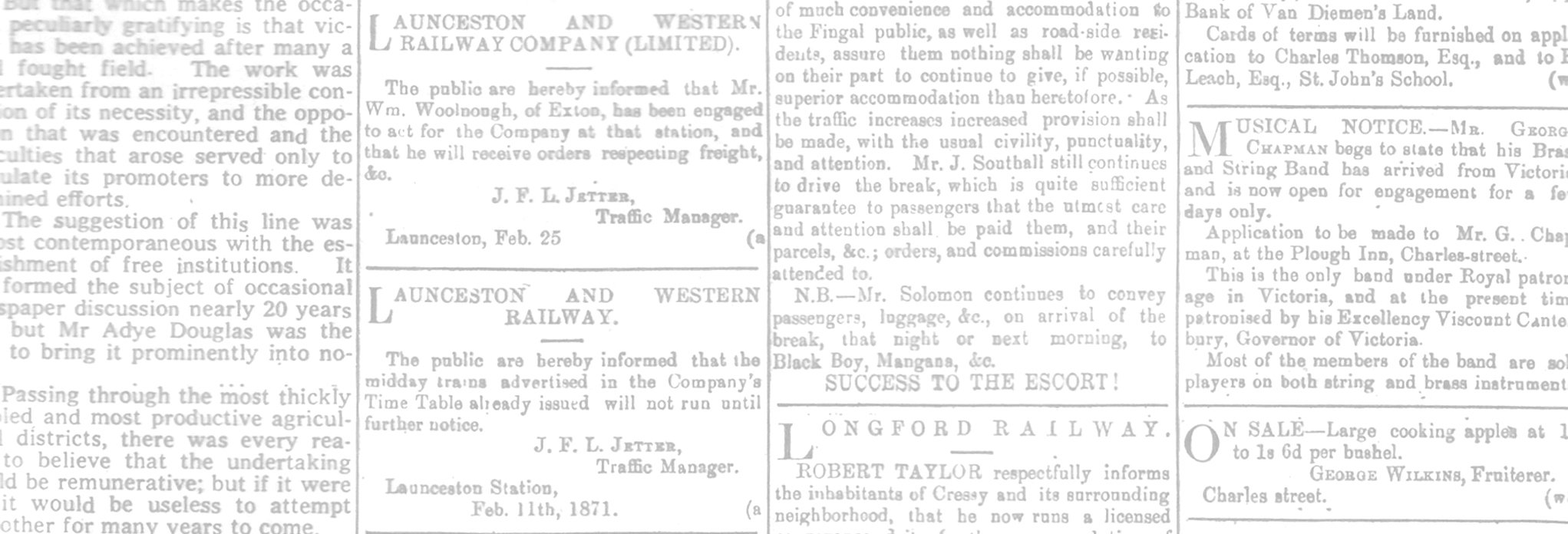
19th Century News
Newspaper articles and advertisements that offer insights into life in Bothwell during the 1800s.
Sources Used: TROVE. Images. National Library of Australia. https://trove.nla.gov.au; FamilySearch: Australia, Tasmania, Government Gazette, 1833-1925. Images. https://www.familysearch.org.
BOTHWELL - 27 March 1865
The dull monotony of this quiet township - a monotony, I believe, pertaining to most of the country places situated off the main line of road - was agreeably relieved on Thursday by an influx of the resident settlers and their families, together with several visitors from "other parts" who had received an "invite" from the Warden and Councillors of Bothwell to a ball to be given by them in the evening at the Castle Inn, kept by Mr Edward Bowden, which took place accordingly. The guests, who numbered about sixty, began to assemble about 9 p.m., and, as they arrived, were politely received and welcomed by the Warden and Councillors. As soon as a sufficient number of those bent on "footing it" were met, up struck the music, and "all went merry as a marriage bell." Dancing was kept up with great spirit, to use a hackneyed phrase, albeit a true one, until midnight, when the ladies were conducted into the supper-room, a large spacious apartment, where was laid out a repast, which, without entering into particulars, I will simply say, might be equalled, but could not be surpassed. The tables were loaded with every description of edibles, solid and light, together with luscious fruits, such as grapes, pine apples, peaches, &c., that could gratify the stomach of the greatest "gourmand' in the colony, or please the palate of the most tasteful and fastidious; the wines were pronounced by tolerable judges as excellent, and champagne flowed fast and free, The Warden and Councillors (may their shadow never be less) had determined that no expense should be spared in providing for the enjoyment and entertainment of their guests, and certainly "mine host" of the castle had opened wide his gates, and shown himself not niggardly in carrying out his instructions. I may here mention that Mr Bowden had had the greater portion of the floor of the ball room taken up and relaid, and kindly gave up the whole of the apartments in his house for the occasion, some of which he had gone to the expense of new papering and carpeting. The ball, supper and refreshment rooms were tastefully decorated with evergreens. For those who did not care to dance, there were provided a card-room, and dressing-room; the former, however, was but little resorted to, and if report speaks true nothing was "lost or won." After supper dancing was resumed, and continued until after daylight. The music, which consisted of the pianoforte with flute accompaniment, was conducted by Messrs Gagliardi and Dentith, and it is only due to these gentlemen to say that they gave universal satisfaction. It was the general remark that this was the very best public entertainment, in every respect, that has occurred in the Bothwell district. Nothing was wanting for the comfort or enjoyment of the guests. After the finale of God Save the Queen, sung by the company, had wound up the evening's, or rather night's, amusement, Dr Sharland, in a short speech, expressed the great gratification himself and family had experienced; he had never spent a more delightful evening, which he was sure was the feeling of all present, and on behalf of all he begged to tender to their kind entertainers, the Warden and Councillors of Bothwell, his very best thanks. I think it would be wrong to omit mention of the very excellent attendance that was provided, and of the pains and trouble taken by Mrs Bowden and her sisters in paying attention to the behests and convenience of their own sex. https://trove.nla.gov.au/newspaper/article/8831866
SECOND COURT - 26 July 1866
ASSAULT. David Norton and Patrick Driscoe were charged on information with having, on the 7th April last, feloniously and maliciously assaulted one Richard Norton, broken his right leg, and inflicted upon him grievous bodily harm. They pleaded not guilty. Mr Graves appeared for the prisoners.
The Solicitor-General opened the case, and called Richard Norton, who deposed: I am a blacksmith, and resided at Bothwell on the 7th April last. I was working as a journeyman for my uncle, David Norton. I went to him on the Saturday afternoon to ask for my week's wages. I had a dispute with him about the amount. He ordered me out of the house. I would not go. Driscoe then came to put me out of the house. I resisted him, and then Norton came, and the two got me down in the yard. David Norton went to a wood heap a few yards away, got an axe, and struck me in the leg with it. Driscoe was then holding me down. I said, "David, you've settled me." He replied "Yes I think that's cooked the ______, let him go." They left me then, and I managed to crawl outside the yard on my hands and knees. I had been drinking during that afternoon, but I knew what I was doing. I lay out outside the gate for half an hour or more before anyone came to my assistance; at last my wife and some other persons came, and I was taken home in a wheelbarrow. Dr Ewington was sent for. My leg was broken below the knee in the thick of the leg.
To His Honour: There was a struggle when I was thrown down. Driscoe beat me about the head and body with his fists. David Norton was then kneeling on me. I have been eight weeks in bed consequent upon the injuries received.
Cross-examined by Mr Groves: My uncle got up off me where he was kneeling on me, and got an axe and struck me. (Witness's deposition taken before the Magistrate was now read) I have been 10 years in Bothwell. I have been working off and on with my uncle during that time. I was at Mrs Triffett's, the publican's, from 2 o'clock till 5 o'clock on the Saturday afternoon. I was drinking there. I like a glass, but I don't get drunk. I am not violent when drunk. I don't remember striking my father with an iron bar. I would not swear I did not. I never threatened to shoot my mother. I never presented a gun at her. I was fined £5 on one occasion. It was not for a brutal assault upon my wife. It was merely for pushing her down. I did not drink beer with Driscoe when I returned to the shop at 5 o'clock. I swear I did not send Driscoe for 2s worth of beer. I was the worst for drink, but I can remember all that occurred on that occasion. I do not remember when I was ordered out of David Norton's house, having knocked my aunt down. I could not swear that I did not do so. I do not remember seeing her there. I swear that I did not strike David Norton before Driscoe laid hands on me. Driscoe and I did not fight in the yard before I fell. William North was called three times upon his subpoena, but did not answer. Mr Graves said he believed Mr North had been thrown out of his chaise cart at Melton Mowbray, and so seriously injured as to be unable to attend. The Solicitor-General said of course if this was the case the recognisance would not be entered. The Chief Justice said he ordered and adjudged that the sum named in the recognisance should be absolutely forfeited, and paid within six weeks.
William Frederick Ewington deposed: I am a duly qualified medical practitioner now practising at Bothwell. On 7th April last I was called in to attend one Richard Norton. He was in bed at his own house. The large bone of the right leg was fractured about five inches below the knee. It was a bad simple fracture. The skin was bruised on the right leg. It seemed as if some heavy instrument had been used to cause the fracture. The head of an axe might have caused the fracture. I examined both legs, and there were marks of blows on the left leg. I should think the blows there were caused by a kick. I think that one blow must have caused the fracture, but from the marks on the right leg I think there must have been two blows. The bone was splintered above. The prosecutor was under my care for seven weeks and three days. When I first saw him, he was under the influence of drink. He knew people and was rational.
William Stokell, a shoemaker, resident at Bothwell, gave evidence as to having witnessed the row in Norton's back yard. He described the action of the parties as far as he could, but said there was a fence between him and them. He saw David Norton stoop, but could not say that he picked up an axe.
Witness was cross-examined by Mr Graves. Richard Norton, recalled, said he adhered to the statement that David Norton picked up the axe, and it must be a misunderstanding of Mr Quodling that he had said Driscoe did it. Mr Quodling told him at the Police Court that he had said so, and witness replied that he was quite wrong, but that Driscoe was aiding and assisting. Mr Graves then addressed the jury, and said he agreed with the learned Solicitor-General that the charge was a serious one, but he submitted that the jury could not come to the conclusion that both the prisoners were guilty.
The learned counsel commented on the evidence of the prosecutor, and pointed out certain discrepancies in it. He addressed the Court at great length, submitting that the case was at best only one of common assault, and he maintained that no more violence had been used than was necessary to protect defendants from the violence of the prosecutor. The evidence in reference to the blow with the axe was not at all clear, and he thought that they could not find the prisoner Norton guilty, while at most the case against Driscoe would only be one of common assault.
He called David Nox, who said he had lived for ten or twelve years with David Norton. He saw him on 7th April pay Richard Norton £1 8s. Richard said it was 2s short. Dick gave Paddy Driscoe 2s to go and get half a gallon of ale. Driscoe brought the ale to the shop, and witness had a glass of it. Dick was very drunk and disagreeable. Witness then went into the house. Presently Dick came and kicked the lock of the door, and struck David Norton's wife. Mrs Norton told witness to go for a constable, and Richard told him if he went he would knock his brains out. Witness then sat down. Paddy then came to the door, and Richard Norton struck him, and the two went into the yard to fight among the wood where there was scarcely room for them. Witness did not see any more. Norton pulled his wife in and bolted the door. Richard Norton has been working there several years, but they have been obliged to turn him away through his drunkenness and blackguarding. No one could live with him; he is so bad for that sort of thing. The witness was cross-examined by the Solicitor General.
James Dalwood, a farmer at Bothwell, deposed to having heard a dispute between Richard Norton and the wife of David Norton. Richard Norton struck her, and David told him he was unmanly, when a row ensued. He went away and afterwards heard that Richard Norton's leg was broken.
His Honour now summed up at very great length; the jury, after an absence of half an hour, returned a verdict of guilty against David Norton of wounding with intent to do grievous bodily harm, but, as acting under circumstances of great provocation, they recommended him to mercy.
They found prisoner Driscoe guilty of common assault.
David Norton, on being called upon for sentence, said he submitted himself to the Court. Driscoe said the same. His Honour addressed the prisoner Norton at length, regretting that one so long known in the district as an honest, industrious man, and a man advanced in years, should be placed in such a position. He sentenced him to be imprisoned for twelve months. Driscoe was sentenced to be imprisoned for eight months. https://trove.nla.gov.au/newspaper/article/8840667.
WILLIAM KNOWLES - 8 October 1866
BOOT and SHOEMAKER (successor to Mr D. Hunt) returns his sincere thanks to the inhabitants of Bothwell, and the public generally, for their liberal patronage, and respectfully solicits a continuance of the same, assuring them that nothing shall be wanting to deserve their support, and that good workmanship and attention to orders shall always be observed. Elizabeth Street, Bothwell, September 27th, 1866.
https://trove.nla.gov.au/newspaper/article/8841985
CHILD LOST - 13 October 1866
Another of those sad catastrophes, which have been frequent of late, recently occurred at the Shannon, in the district of Bothwell, the particulars of which are as follows: On the 22nd of July a shepherd named Reardon, with his family, in the service of Frederick Synnot, Esq., was removed from one hut to another, the distance between them being about a mile, and scarcely had they settled their furniture within their new homestead, when they missed one of their children, a lad 3½ years old, named Edward. Search was immediately made, the distracted parents being assisted by all the residents near them, including Mr Synnot, the Messrs Atwell &c., but no trace of the poor little fellow could be found. On the following day as many as twenty persons turned out, including the Superintendent of Police and several residents from Bothwell, and although the search was continued for nearly a week, no sign whatever of the unfortunate boy has up to the present moment been found. The child, although so young, was remarkable for his intelligence, and this circumstance makes the loss the more painful. When he was last seen he had neither hat nor shoes on, and was otherwise but very lightly clad, and as the frosts about this time were unusually severe, it is conjectured that he must have perished the night he was first missed, and that all traces of him have been destroyed by the vermin, which in this locality are particularly numerous.
https://trove.nla.gov.au/newspaper/article/8841030
COUNTRY NEWS - 14 December 1866
On the 11th December Bothwell was visited with a thunderstorm, the like of which is not remembered by the "oldest inhabitant." During the whole of the day the heat was excessive, and the sun most glaring, but towards the evening the sky began to be overcast, and dense black clouds were observed in the south-west, which, gradually extending, eventually spread over all the township, accompanied by loud claps of thunder and lightning, portending the coming storm, the extent of which, however, was little foreseen. About a quarter to seven o'clock a violent gust or two of wind blowing up the dust in eddies was experienced, end almost immediately afterwards, down came a terrific hailstorm, succeeded by very heavy rain, loud thunder, and both forked and sheet lightning. In an almost incredibly short time a small watercourse, running through one of the back streets, and the paddocks of Messrs Bowden and Robinson and through the garden of Mr Quodling into Arthur Crescent and Patrick street, and which previous to the storm was perfectly dry, was converted into a perfect torrent, covering a broad piece of Mr Bowden's hay field, submerging nearly the whole of Mr Robinson's garden, and of course a portion of his paddock, entirely submerging the garden of Mr Quodling right up to the steps of his front door, pursuing its course through the lower ends of Arthur Crescent and Patrick-street aforesaid down to the river. Such was the height and violence of the current that it carried away several panels of post and rail, and paling fencing belonging to the above named parties, some of which were found lying in Patrick-street next morning. Mr Bedford, who it appears was returning home from his run, in the midst of the storm, had as much as he could do to get his horse and dog-cart across the stream in the street between the residences of Messrs Quodling and Easton. The storm lasted until about half-past eight o'clock; during the whole period the thunder and lightning were almost incessant. The hailstones were very large, and have, no doubt, caused considerable damage. Some panes of glass in the Police office have been broken. The weather seems far from cleared up today; it is very cloudy and beginning to drop slightly with rain. https://trove.nla.gov.au/newspaper/article/8843273
BOTHWELL - 28 March 1867
PRESBYTERIAN SUNDAY SCHOOL. The township of Bothwell, usually so quiet, and it might be said monotonous in its everyday life, expressed an agreeable change for the better on Saturday the 16th inst. by the assemblage of its entire population as well as members from the surrounding neighbourhood to witness the interesting ceremony of laying the foundation stone of a new Sunday school-room by His Excellency Colonel Gore Browne, who with Mrs Gore Browne, Captain Steward and party, were on the return from an excursion to the country in the vicinity of the Great Lake. The Governor arrived punctually, according to appointment, at 1 o'clock and was conducted to the site by the trustees. The building being of a religious character, the Rev. Mr Hesketh opened the proceedings with prayer. The Rev. Andrew Blackwood reading the 104th psalm, after which an appropriate hymn for the occasion was sung by the children of the school and by many others of those present. A bottle containing the following inscription neatly engrossed on parchment was then deposited in the cavity of the stone by Mr Simon Arnett, a trustee: The foundation stone of this building to be styled "the United Episcopalian and Presbyterian Sunday school" was on this 16th day of March, A.D., 1867, in the 30th year of the reign of Her Majesty Queen Victoria, laid by his Excellency Colonel Thomas Gore Browne, C.B., Governor in Chief, Vice Admiral &c., of Tasmania and its Dependencies Trustees, Archibald McDowall, Esq., Warden of the District; Mr Andrew Blackwood and Mr Simon Arnett, Superintendent of School, Mr Archibald McDowall, Teachers Mr William Stevens, Mr William Hughes, Miss Amelia Allen, Miss Jessie Moyes, Miss Emma Hughes, and Miss Sophia Whiteway. The visitors of the school being the Rev. W. M. Hesketh, M.A., and the Rev. Andrew Blackwood, Presbyterian. Architect - E. C. Rowntree of Hobart Town. Contractors and Builders are Mr James Easton and Messrs Anderson and Stevens. Cost of building £220. Along with this document were deposited the following British coins, viz., one crown piece, one half-crown, one shilling, one sixpence, one fourpence, one threepence, one penny, one half-penny and one farthing, also a copy of The Mercury newspaper, of this date, published at The Mercury Steam Press, Hobart Town. The corner stone having been then lowered into its place by the builders, Colonel Gore Browne striking it with the trowel in the usual manner declared it to be "well and truly laid." and in a most appropriate speech, which was listened to with evident satisfaction, expressed the pleasure he experienced in having had it in his power to lay the foundation of a building to be devoted to such a praiseworthy object as the religious instruction of the young, dwelling on the many advantages likely to result from the establishment of this and similar institutions throughout the country, and in language, which we cannot pretend to report correctly, expressed the warmest sympathy with the object for which the school was to be erected and heartily wishing it every success. A vote of thanks to His Excellency for his kindness in attending on this occasion was then proposed by Mr McDowall, and responded to by three cheers for the Governor, and three for Mrs Gore Browne. A collection was then made in aid of the funds, which was liberally responded to; notwithstanding which, the funds requisite for the completion of the work, it was stated, are still in arrears. https://trove.nla.gov.au/newspaper/article/8844923
FATAL ACCIDENT AT BOTHWELL - 22 May 1867
A very shocking accident occurred on Wednesday last at the township of Bothwell, by which a fine little girl, aged about ten years, named Julia Craig, daughter of a man named Henry Craig, formerly in the rural police, but now obtaining his livelihood by wood carting, met her death. It appears that Craig was loading his dray with heavy logs of wood close to the door of his house, when his daughter jumped up on one side, he being on the other. He saw a log of wood fall from the dray, the little girl falling with it, and immediately ran around to her assistance, when he found the child lying on her back under the log, which had fallen upon her chest from a height of about four feet. He lifted the log off the child when the blood gushed from her nose, mouth and ears. She never spoke, but expired in about two minutes after the occurrence. Dr Campbell was at once sent for. An inquest was held at Bothwell on the following day, and a verdict returned in accordance with the facts. https://trove.nla.gov.au/newspaper/article/72182243
A SAD ACCIDENT - 13 April 1868
On Friday afternoon last, a very painful accident occurred near Bothwell. Two brothers, named Robert and Joseph Blake, were out in the bush kangarooing, and parted company in order to way-lay the game. Shortly afterwards a kangaroo crossed before Joseph Blake, while his brother, unknown to him, was on the look-out behind some scrub in the line of fire. Joseph fired at the animal but missed it, and the shot scattered among the bushes where Robert was, several of them striking him and inflicting severe wounds. One passed through the cheek at an angle, lodging behind the right ear, one lodged in the abdomen, one in the left knee, one in the left ankle, and another in the left arm. The young man bled profusely from the wounds, but every assistance was at once rendered him by his brother. He was conveyed to Bothwell, and from thence to town, where he arrived Saturday morning. He is now under the care of Dr Crowther, and is doing well. https://trove.nla.gov.au/newspaper/article/8851566
BOTHWELL - 11 July 1868
The monotony which ordinarily pervades this township was broken through on Monday, the 6th inst., and considerable stir, bustle, and excitement created by the advent thereto of several country gentlemen whose faces are not seen every day in the week, some as J.P.'s to attend a Court of General Sessions, others to a Board of Works' meeting to be held immediately afterwards; there were also to be seen a number of persons ambitious of employment under the Board waiting about anxious to learn the result of the tenders they had sent in, and a suitor or two under the Small Debts Act.
The "great event" of the day, however, and which drew forth the largest concourse of people was a flat race, to be followed by a steeplechase to be run over the old and lately neglected Bothwell course. This latter affair had been fixed to come off at 12 o'clock noon, but the "promoters of the undertaking," (to borrow a phrase out of our Waste Lands Act) two gents belonging to the Hamilton district, on its being intimated to them that several admirers of the sport would be unable to attend and witness the race in consequence of their prior engagements, like men of sense at once gladly consented to allow business to take precedence of pleasure, and postponed the affair until after 2 p.m.
It is time to hasten to the race course where a very large number of "sightseers" had already assembled, including most of our landed gentry, nearly the whole of the inhabitants of the township, and several strangers from adjoining districts. The preliminaries usually undergone on regular racing occasions having been entered into and adjusted, the nags, one a black, the other a bay, both ridden by gentlemen riders, made their appearance. At the word "off" both horses started fairly side by side together, but they did not keep that position long; the black soon shot ahead several lengths, and kept his opponent at the same distance apart right away to the winning post. The same result attended the steeplechase between the same two horses and same riders; the black in this race took the lead over the first fence, a four railer, and kept it the whole way round. Both horses struck the top rail at first leap, the black incurring no inconvenience; the bay, however, nearly fell, causing his rider to make sundry gyrations, and had he not had at the time a good fast grip of his saddle, somewhat after the fashion of "grim death to a lee backstay," he undoubtedly would have "come to grief." On recovering his proper seat, off went man and horse again, taking the fences in beautiful style, the same as their leader, right away home to the trysting place without hindrance or accident. The race, it was said, was got up more for the sake of testing the paces and capabilities of the horses than anything else, the stakes being only £5 a race. The affair, slight as it was, caused considerable interest and amusement in these dull times, and was fortunately unattended with any accident or unpleasantness.
A Board of Works meeting was now held; there were seven tenders for supplying and erecting the telegraph poles between Bothwell and Melton Mowbray, and the fortunate tenderers were Messrs James Moyes and Joseph Blake, price at the rate of 9s per pole; the highest tender was at 14s. Messrs Moyes and Blake also received the contract for the Blue Hill and Ouse Road, Mr Polkie for the work at the Jordan Bridge, and Mr Webb for some work on the Shannon Road. After other requisite business had been disposed of, the meeting broke up.
The insulators and wires have been sent for to England, and are expected to arrive in the colony about December, when the apparatus will be fixed up under the immediate directions of the Inspector of Electric Telegraphs. https://trove.nla.gov.au/newspaper/article/8853299
HEAVY SNOWFALL - 20 July 1868
On Saturday morning a scene met the eyes of the inhabitants which will not soon be forgotten. We had already noticed the fall of snow which occurred on the previous day, and this continued at intervals for some time during the night, so that in the morning the streets, houses, gardens and paddocks, with the surrounding hills, were covered with a complete coat of snow, white and to our inexperienced eyes being almost dazzling. We are told that in some parts of Oatlands and the Bothwell district it lay two feet deep. The day was fine overhead but very cold. https://trove.nla.gov.au/newspaper/article/8853468
THE LATE THUNDERSTORM - 1 March 1869
To the Editor of the Mercury. Sir, the thunderstorm mentioned in your columns Monday last, my brother John and myself happened to witness. We were going to the Lakes, driving horses, when opposite Hunterston, about halfway up the Shannon Tier, we were caught in what will be to us an ever memorable storm of thunder, lightning, hail and rain. It began about half-past two o’clock. The hailstones were about the size of pigeon’s eggs, falling with great force, bouncing off the road over the fence, and cutting the bark and leaves off the trees, driving the horses mad, for we had some difficulty in keeping our seats. The loose horses rushed their heads in the fence and under each other. The thunder was louder and closer than I ever heard it; the lightning was all around us and for a moment appeared to set the trees on fire. It struck the top of a tree fifty yards from where we were standing, coming down through the limbs to the ground, grooving the trunk of the tree a foot wide and three inches deep all down, scattering the shattered pieces over the fence and fifty yards from the tree. The hail was about three inches deep on the ground, and clogged up in the horses’ feet a great deal worse than snow. The tree referred to stands just above where the new road goes into the old one, and is about 60 feet high. Yours &c., G. W. IBBOTT. Ibbott Vale, Bothwell. February 26th, 1869. https://trove.nla.gov.au/newspaper/article/8857501
BROWN TROUT IN THE CLYDE - 27 May 1869
A Bothwell correspondent writes - "It may not prove uninteresting to yourself and your numerous readers to be made acquainted with the fact that the attempt to stock the river Clyde with salmon trout is likely to turn out successful, one of the above-named fish, measuring 14¾ inches and weighing 24 ounces, having been taken alive out of an eel trap near Mr Taylor's mill at Thorpe, on the 24th May. This will prove the adaptability of the Clyde waters for the propagation of the aforesaid fish, and at the same time the necessity of an amended Clyde Water Act, to enable the trustees to frame bye-laws for their protection. It is just 13 months since a number of brown trout were brought by our Warden, accompanied by Mr Mandeville and other assistants, from the salmon ponds at Redlands, the largest fish being not more than four inches in length, and deposited in various parts of the Clyde, namely 24 at Montacute, 26 at Bothwell (that is adjacent to the township), 13 at Norwood, near Nant and 71 close to Lake Crescent. https://trove.nla.gov.au/newspaper/article/8859219
A VELOCIPEDE JOURNEY TO BOTHWELL - 28 May 1869
We noticed in our Tuesday's issue that a resident of Bothwell made the journey to Hobart and back on a velocipede, and we are now in a position to give the following particulars of the return trip. The individual referred to left Hobart on Monday morning (24 May), and accomplished the whole journey the same day, reaching home that night. He writes us as follows - “Considering the state of the roads after the late rains; that it was raining nearly the whole journey and a great portion of the road is newly metalled, I must say I was much surprised myself at the accomplishment of the feat. I had been trusting to the roads drying up before my return journey, but was woefully disappointed by the rain of Sunday night and Monday. I may add that the only object I had was to demonstrate to myself the practicability of this mode of travelling, which I am now perfectly satisfied of on fair roads. The present state of the roads, and the Den Hill on the Bothwell road, are cases that must not be bargained for with such a steed. My machine is furnished with an odometer (or mechanism for registering the distance travelled), of my own contrivance, which acted with the greatest accuracy, making a difference of only 2 chains between going and returning.” The velocipede was made in Bothwell by Mr Wise. Our correspondent further informs us that he is satisfied he could perform the journey to Launceston, 120 miles, in fair weather, in two days, with far greater ease than he accomplished his journey on Monday. https://trove.nla.gov.au/newspaper/article/8859244