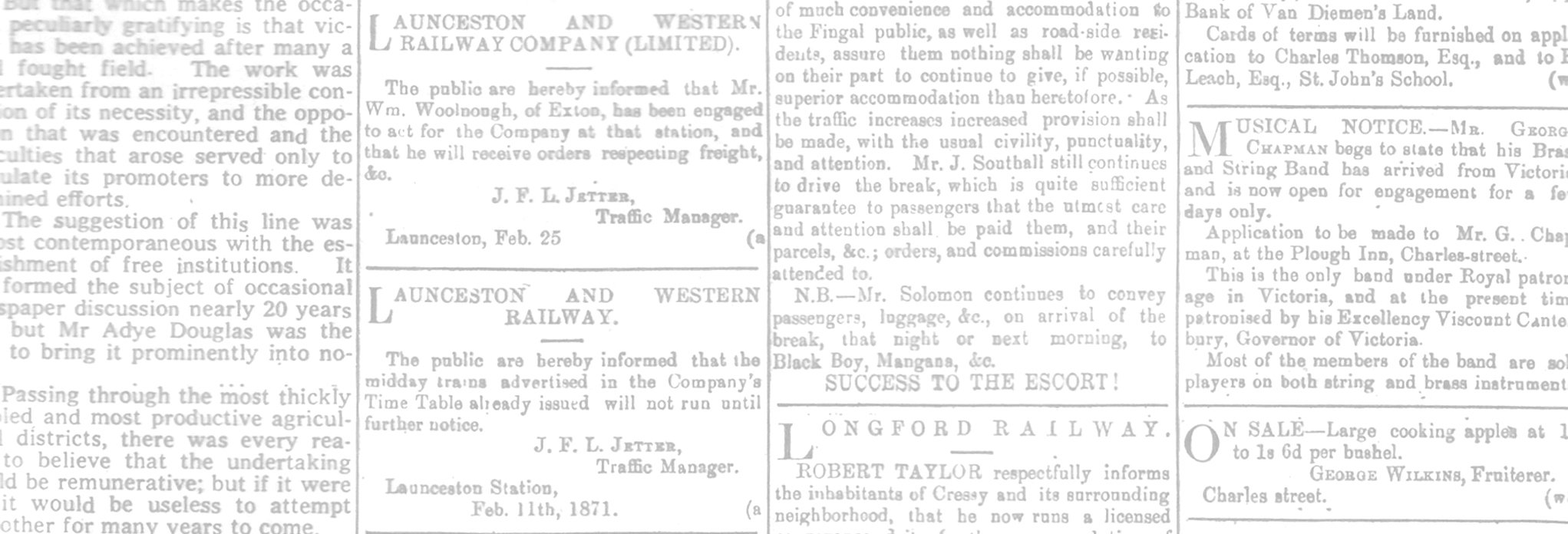
19th Century News
Newspaper articles and advertisements that offer insights into life in Bothwell during the 1800s.
Sources Used: TROVE. Images. National Library of Australia. https://trove.nla.gov.au; FamilySearch: Australia, Tasmania, Government Gazette, 1833-1925. Images. https://www.familysearch.org.
COUNTRY NEWS - 31 March 1860
A grand picnic was given at this place on the 28th March, at the joint expense, we believe, of Edward Nicholas, Esq. of Meadsfield, and Mr and Mrs Axford of Thorpe, whose liberality and unostentatious hospitality are well known to “all and sundry.” The site was well selected, being on a hill commanding a very pretty view of the township and adjacent country including a glimpse of the mountains to the westward. About 60 persons were present, among whom I was happy to see our worthy member Captain Langdon, who looked as fresh and active as many a one who had not yet reached his prime. With regard to the ladies, most of whom were elegantly attired, I shall only remark that they all looked charming, especially the young ones, and if any “absentees” would like to know "more about them" he will be able to purchase their likenesses at Mr Ife's store at Bothwell, Mr Park having taking them “on the ground” by means of his photographic apparatus. Amongst the amusements provided was that of the game of archery; “apropos” of this, one gentleman evidently despising the fair archeress's skill, boldly stood in front of the target, but she, knowing him to be a Benedict, disdainfully shot an arrow through the skirt of his coat; had he been a young bachelor it was slyly remarked she would have aimed more in the region of the chest. Mr and Mrs Moyes of the “Crown” were the caterers for the eatables, and to do them justice, they performed their parts well; they had erected a first-rate commodious booth, the posts being entwined with wattle, carpeted the same, and exhibited a “spread” which for excellence, abundance, variety, and elegance, would not have disgraced Government House. May it not be the last. This is the second picnic given here this season, the first took place about a fortnight back at the Falls for which the inhabitants were solely indebted to the liberality of Alexander Reid, Esq., of Ratho, and family; and the delightful manner in which that “went off” gave birth, it is presumed, to its successor.
SHOCK OF AN EARTHQUAKE. I take up my pen to inform you that the shock of an earthquake was distinctly felt at this place a little before 6 a.m. yesterday, the 28th March. I was in bed at the time, when all of a sudden I was awoken by a loud rumbling noise, as though some very heavily laden carts were passing out of the yard close by my bedroom window (my room is on the ground floor, and at the back of the house), and presently afterwards my bedstead distinctly vibrated backwards and forwards. My son and daughter, occupying rooms overhead, were both awoke from their sleep, the latter afterwards informing me that she felt her head move backwards and forwards on the pillow. My servant girl also felt it, and called out "Is that you, master?" thinking I was making a noise to awake her. I subsequently ascertained that my neighbours on each side heard the noise and felt the sensation, as also others on the township. Mr Quodling, C.D.C., likened the noise to a heavy goods train passing along the railway. Later in the day, I found that the shock had been felt by Mr Edward Nicholas, of Meadsfield, and all his family; by the Sherwood residents; and also by Mrs Mitchell, of Buerton, and at Nant. About seven years ago, the shock of an earthquake was felt at the Shannon, as I have been informed by the Messrs Howells, but the one yesterday is the first I believe that has ever been experienced on this township.
https://trove.nla.gov.au/newspaper/article/1947068
BOTHWELL PLOUGHING MATCH - 9 August 1860
This event came off on Tuesday the 21st instant, and was well attended; the ploughing was good and workmanlike, especially that of Mr John Palmer Jnr, of Bagdad. For the adults' prizes, twelve ploughs started, the result being as follows: ADULT'S PRIZES. 1st Prize - Mr John Palmer Jnr, Bagdad - £13. 2nd Prize - Mr Edward Fox, Jerusalem - £11. 3rd Prize - Mr Charles Jones, Lower Marshes - £8. 4th Prize - Charles Blake, ploughman to Mr William North, Bothwell - £6. 5th Prize - George Vigar, ploughman to Mr McDowall, Bothwell - £3. 6th Prize - Richard Allen, ploughman to Mr Archibald McDowall, Bothwell - £1.
https://trove.nla.gov.au/newspaper/article/8792697
BOTHWELL - 21 November 1860
November 21, 1860. THREE MONSTER ALLIGATORS WILL BE EXHIBITED AT Mr WHITEWAY'S, HOTEL, on FRIDAY, the 23rd, AND SATURDAY, the 24th NOVEMBER. Full particulars in Bills. Admission, 1s, Children, 6d. Open from 10 to 10.
https://trove.nla.gov.au/newspaper/article/8794505
IRRIGATION - 30 January 1861
Mr Martelli's progress report on Irrigation, the general features of which we have already announced, is now in the hands of the Printer. The following memoranda on the same subject, as far as relates to the Cumberland, were prepared by Mr H. M. Hull in the year 1857, and presented to the Royal Society at the instance of Sir Henry Young. As Mr Hull and Mr Martelli have both travelled over nearly the same ground, it will be interesting to compare the two reports and note the coincidences between them. Mr Hull's paper, dated four years back, is as follows:
Report by Hugh Hull Esq., J.P. on present Irrigation in County of Cumberland. Presented to the Royal Society by Sir Henry Young, 15th July, 1857.
Agreeably to His Excellency's wish that I should "give him a statement of what has been done up to this time in the way of Irrigation in the County of Cumberland, and with what results; and also state what are the capabilities of the District for systematic Irrigation," I beg to report:-
1. That Irrigation has during the last 15 or 16 years been employed in this District for the purpose of improving the little valleys (or bottoms as they are locally called) on each bank of the Clyde, and also on the eastern side of the Ouse River, and on the Shannon River; but the works have, with one or two exceptions, been of an inexpensive nature, and not extensive in their operations. But the result has been in all cases so satisfactory that it is astonishing these works have not been carried to a much greater extent. Two or three reasons may be assigned for this: first, the uncertainty of a Summer supply of the water in the Clyde, owing to the wilful destruction of the dam at Lake Crescent, and the refusal of the owner of the adjacent land to permit its re-erection. Second, the objection of certain proprietors to allow cuttings to be made through their lands to convey water by which they would not be benefited, and thirdly, by the want of an energetic and speculative spirit on the part of proprietors to expend capital in works the benefits of which might not repay them for some years, or lastly, the want of capital to do works which would be so valuable to the Colony.
2. I have explored the banks of the Clyde for 25 miles - those of the River Ouse for 20 miles; the Dee for about 10 miles, and those of the Shannon with its rocky bed for 15 miles. I have also explored the Exe Rivulet and the Jordan River; and after my ride of nearly 200 miles, I am of opinion (although not a surveyor) that 20,000 acres of land on their several banks may be easily irrigated, if good Heads of Water can be secured during the summer. I have conversed with nearly all the large settlers in the country, and from their opinions I gather what I now say, - that, by damming lakes Crescent and Sorell (both of which lakes I have just visited,) a very large head of water can be secured ; (the expense estimated by an experienced gentleman at £80 only). Those two lakes contain, it is estimated, 24 square miles of water; if raised three feet this would give 72 millions of square yards of water, or in round numbers 4,000,000 gallons a day available, every drop of it, for Irrigation purposes, and then with sufficient fall to drive the two mills at Bothwell and the mill at Hamilton. The River Clyde can, without much expense, be led into the Exe Rivulet, which falls into the Jordan, and thus would give the means of irrigating the extensive valley of Cross Marsh and Bagdad Plains. To keep up the supply of the Clyde, the Shannon can, by a five-mile cutting, be brought into Mount Pleasant Valley, of 1,000 acres, on to Weasel's Plains, 2,000 acres, and then to the Clyde. The Shannon contains three times as much water as the Clyde, and takes its rise in the Great Lake, which is about 60 miles in circumference, and the mouth of which, being rocky, can easily be dammed. A dam at Halfmoon Marsh near Burford village, on the Clyde, would enable us to take the water out on each side, and command a very large extent of country all available for Irrigation. At Dennistoun nearly 2,000 acres of bush pasture are now roughly irrigated at a comparatively trifling expense. The soil is sandy, and is much benefited; more so than clayey soils, on which where irrigated, rushes grow, although richly intermingled with white clover, the seeds of which are borne into every corner by the flowing water. If the water be taken out at Halfmoon Marsh it could be carried above Dennistoun House, round by Fordell, Thorpe Mill, Logan, and then into Bothwell at a high elevation, and on the other side of the Clyde, it would command Blair, Cluny, Ratho, and other extensive farms with their vallies.
3. As to the value of Irrigated Land, I gather that where one acre of bush pasture will feed a sheep per annum, one acre of irrigated land will feed five. If the land had been ploughed and sown with English grasses, it is worth, when irrigated, from 20 to 30 acres of dry land. The paddocks at Meadsfield and Sherwood - evergreen, and nearly knee deep in clover - speak volumes for the value of irrigation; while the prices which the Meadsfield wethers and the Sherwood butter command, fully compensate the spirited owners of those properties for their outlay.
4. Shannon - At Hunterston, on the Shannon, 500 acres are irrigated at a trifling annual expense; and by a cutting of about 5 miles to Mount Pleasant, at a cost of about 20s a rod, or £300 a mile, the water could be conveyed to Mount Pleasant and on to the Clyde. Messrs Howell irrigate some paddocks from the Shannon…
I may be allowed to remark that the benefits proposed to be secured to the 2600 inhabitants of the County of Cumberland by the bill now before Parliament for securing the sources of the Clyde, might be greatly extended by permitting such dams to be erected at Lakes Sorell and Crescent, and also along the Clyde; it would place at the disposal of the settlers a good head of water for Irrigation purposes, the distribution of which might fairly be left in the hands of Trustees residing in Bothwell and Hamilton, and the works themselves protected by a resident overseer. £10,000 raised by debentures expended in these works on the Clyde, the Ouse and the Shannon would, were the lands benefited assessed at a low rate, not only be repaid in a few years, both interest and capital, but the results which would soon be evident to the Hobart Town market would lead to the rapid progression of the district, and to the extension of summer sheep runs far away beyond the Great Lake and Lake St. Clair, towards the V.D.L. Company's settlements on the Surrey and Hampshire Hills; - the half million of sheep now depastured in the district would be fattened, and the Victorian market for coarse mutton superseded. The Irrigation rate might be collected by the police or municipal authority, in the same way as the road assessments, and any local repairs be done under the same authority.
I regret that I cannot spare time to go more fully into this important subject, but on looking at the map His Excellency will see that it is to the county under my care that the colony will have to look, not only for a large portion of its annual land revenue, but also from its great advantages of lakes and rivers and plains, as the great field of future Irrigation, and for its supply of meat, should the Victorian market fail.
Respectfully submitted by HUGH M. HULL.
https://trove.nla.gov.au/newspaper/article/8796008
ACCIDENT - 31 July 1861
MR SYNNOT, M.H.A. We regret to state that Frederick Synnot, Esq., the newly elected member for Cumberland, has met with a serious accident, which will prevent him from taking his seat in Parliament when it assembles, and for some time afterwards. Mr Synnot was upon the point of returning home from Bothwell about seven o'clock on Saturday evening last, had mounted his horse in the Crown Inn yard, and had got a few yards from the gates into the street, when the horse began to plunge, and threw him violently on his back across a newly made drain, thereby causing a fracture of the right thigh-bone, near the knee. Dr Black, who was away from home at the time, was immediately sent for, and on his return, the leg was set, and on Monday morning Mr Synnot was doing well. https://trove.nla.gov.au/newspaper/article/8800115
BUSH FIRES - 8 March 1862
For several days extensive bushfires have been burning on the Cluny estate, and other localities near Bothwell, destroying a large amount of fencing, and the inhabitants having to be up constantly night and day, so as to keep the devastating element at all under. We also hear great complaints on account of the continued drought. https://trove.nla.gov.au/newspaper/article/8805018
TO THE EDITOR - 17 October 1862
October 17, 1862. Sir, I beg to contradict a notice of marriage that appears in the papers of the 7th October, between myself and Thomas Gregory Brown, as no such thing ever took place at my residence, by the Rev. L. Campbell, or anywhere else. Yours respectfully, M. A. Denholm. Pool's Marsh, Jericho.
https://trove.nla.gov.au/newspaper/article/8811696
ACCIDENT BY BURNING - 20 January 1863
We regret to have to announce an accident of this nature, which occurred to Mrs Ann White of Bothwell, a very old and respected resident in that district. The particulars we have not heard, but we are given to understand that the injuries sustained are of so severe a character that little hopes are entertained of her ultimate recovery.
https://trove.nla.gov.au/newspaper/article/8814582
HOBART TOWN AND THE SOUTH - 24 January 1863
On Monday, a fearful accident occurred to the wife of Mr John White, storekeeper of Bothwell, who, it appears, was attending her usual duties in the kitchen of the dwelling house, which is some distance from the place of business, at which the other members of the family were engaged, when, by some mishap, her dress took fire, and there was no one else in the house at the time to assist her to put out the flames. She ran out of the house, towards the shop, but before she proceeded far, tried to put out the flames by rolling on the ground, when a woman, who was washing, attracted by her screams, ran and succeeded, by throwing water upon her, in putting out the fire, but not, unfortunately, before the poor sufferer was dreadfully burnt. Dr Campbell was speedily in attendance, and applied the usual applications, but little hopes are entertained of her recovery, as the unfortunate lady is advanced in years, and is very severely burnt.
On Monday morning, the 19th, intelligence was brought in from the Blue Hills, that a lad, about 11 years of age, son of a shepherd named John Pulford, in the service of Mr Duncan McRae, of the Blue Hills, had accidentally shot himself, whilst out shooting opossums the previous evening. Dr Campbell at once proceeded to the scene of the accident, although, from the account brought in by the messenger, he had but slight hopes of his arriving in time to be of service.
https://trove.nla.gov.au/newspaper/article/41458558
GREAT FLOOD - 22 December 1863
The weather throughout the whole of the spring quarter now closing has been remarkably unsettled, and several severe gales have passed over the island. The glass began to fall on the 8th instant, and steadily declined until the evening of Saturday, the 12th instant, when the rain commenced to fall in heavy showers. On Sunday it rained incessantly, the wind blowing strongly from the southward, and throughout Sunday night and Monday morning there seemed no prospect of any abatement in the fury of the elements...
At Bothwell, the Clyde rose to a tremendous height and flooded a great portion of the township. The lower end of Patrick-street, extending to the Rev. Mr Robertson's corner, was completely submerged, the water being two feet deep in the houses in that locality; the inmates had to decamp with their bedding in carts. The water also entered Mr Robertson's house. In Barrack-street, the tail of the flood extended partially on the footpath in front of the Council Chambers, but the back part of the premises was completely underwater right up to the stone steps, and at the lower part of the yard was upwards of two feet in depth. The constable's quarters on the opposite side of the street, a little lower down, was completely surrounded by water, which entered the house, and constable McMahon and his wife and family had to quit.
https://trove.nla.gov.au/newspaper/article/8823405
FLOODS - 24 December 1863
The damage done by the late floods in the Rivers Clyde and Jordan, and various creeks in the district, in the destruction of fences has been immense. Mr Sherwin estimates his damage at £200. Mr Manning, overseer to the Messrs Allison, at the Shannon, informed me that nearly five miles of his master's fences had been carried away, and that, but for timely care, they would have had a quantity of wool damaged. About 170 sheep, which had been recently shorn, were found dead from the effects of the storm of wind and rain, and that Mr Downie has lost a larger number from the same cause.
A very interesting occurrence took place in the public school-room here on Saturday last. It appears that Mr Park, the public teacher, whose connection with the Board of Education ceases at the end of the year, he having sent in his resignation some time back, owing to dissatisfaction with the government, at its having reduced his salary, and who has been fortunate enough to obtain a better appointment at Dunedin, New Zealand, had determined, in conjunction, with Mrs Park, of course, to invite all the children to a "tea meeting", and there and then, as it would be the last occasion on which the present teachers and scholars would respectively meet as such, to take farewell of each other. The consequence was, that about seventy or eighty teachers assembled in the afternoon of Saturday aforesaid, all dressed in their "Sunday best," to partake of the good things their kind entertainers had provided for them, after which, one and all of the children came forward by turns, and were taken by the hand by their worthy teacher, and bade farewell. In the evening, they all assembled again in the schoolroom to witness the exhibition of a magic lantern, which Mr Park had promised them, and which caused them great amusement. Several of the inhabitants were present, and seemed much pleased, the views being very interesting. Many of the children have shown their appreciation of Mr and Mrs Park's indefatigable exertions for their improvement, and the humane rule that has been exercised over them, by presenting their teachers with various little offerings, such as pin-cushions for the toilet, watch-guards, &c., &c., worked by their own hands. One present, consisting of a handsome dressing case, value about £3, purchased by subscriptions raised amongst some of the scholars, was handed to Mr Park on this occasion. Circumstances of this kind speak for themselves, and require no comment. There is no doubt, however, that Mr and Mrs Park well deserve the children's gratitude; for this much everyone will concede to them, that the attention paid by them has been unremitting, neither of them having been absent from their duties a day or an hour during the period of six years they have held the appointment here; and no one competent to form an opinion could be unobservant of the pains that were taken, and the excellent mode that was adopted in imparting the necessary knowledge required, and the orderly way in which the business of teaching was conducted.
https://trove.nla.gov.au/newspaper/article/8823454
NARROW ESCAPE - 7 July 1864
On Saturday last between 11 and 12 o'clock, as Frederick Synnot, Esq., JP, was driving into Bothwell in his gig, to attend a meeting of the Road Trust, he caught up Mr Brown's cart in the Shannon Lane, about a quarter of a mile from the township, and the horse which Mr Synnot was driving being a young one and not thoroughly broken in, in fact, as Mr Synnot stated, one that had only been in a cart three times before, shied, and refused to pass the cart, whereupon that gentleman just touched him with the whip, when he immediately set to kick, but there being a kicking strap no damage was done with his heels. The animal, however, appeared determined not to be beaten, so he then reared straight up, and came down upon his head, thereby breaking both shafts, and pitching Mr Synnot out of the gig head first, within a foot of the post and rail fence; fortunately he was not much hurt, his black beaver most probably saving his head, the horse then got up and made a desperate rush at the fence, which he cleared, and then fell again, when he was secured by one of Mr Synnot's men who had come down from the Shannon with him on horseback; in leaping the fence, the horse disentangled himself from his harness, and broke both shafts again close off to the body of the gig. This is the second narrow escape Mr Synnot has had of late, for on Saturday week last, whilst in the act of dismounting at Mr Brown's door, at Cluny, a boy, who had been sent to take the horse, rushed up rather suddenly, when the same horse reared up, made a plunge, and pitched Mr Synnot, violently over his head, and, afterwards, the horse, in rearing about, put both his feet upon Mr Synnot's chest, causing him severe pain for some time, but, were fortunately, no further injury. https://trove.nla.gov.au/newspaper/article/8827230
BOTHWELL - 19 November 1864
A DARING BURGLARY CASE. A burglary was committed at the residence of Thomas Axford Esq., at Thorpe, during the night of the 15th inst., or rather as Paddy says "about 2 o'clock in the morning" of the 16th.
It appears that about half-past 2 o'clock, Miss E. D. Holland, who has charge of Mr Axford's children, was suddenly awoke from her sleep, and found a man in her bedroom ransacking her box; she immediately jumped out of bed and commenced screaming for assistance, at the same time rushed towards the door, when the fellow picked up her box, and walked off with it, pushing Miss Holland back into the bedroom, and turning the key of the door, which happened to be outside, locked her in. Miss Holland then proceeded to the window with the intention of jumping out, when to her astonishment she found another vagabond with an opossum skin rug on his shoulders pacing up and down in front of it. Miss Holland then heard the man whom she had first seen, in Mr Axford's bedroom opposite, apparently at the drawers, at which it was afterwards discovered that he had been, but without taking anything away.
A Mrs Wilby who slept upstairs, hearing the young lady's cries, ran down and was just in time to see the man leaving the hall with Mr Axford's government Enfield rifle; with great courage she seized hold of the rifle, when the villain turned round and struck her a blow with his fist on the nose, causing the blood to flow profusely. She stuck to the rifle, however, which the fellow at length allowed to remain in her hands, perhaps thinking that the possession of it might more readily lead to his detection. He then left, and Mrs Wilby ran down in her night clothes to Mr Taylor's at the mill for assistance. Both scoundrels decamped in the meantime; but it is much to be regretted that, notwithstanding Mr Quodling and his constables, who proceeded in pursuit within a couple of hours afterwards, which was as early as he was apprised of the matter, even going himself as far as Oatlands and back the same day, no tidings have as yet been obtained of the men. The only plunder taken away were nine sovereigns and a half belonging to Miss Holland, contained in a little box within her work box, which was kept in her trunk.
Unfortunately, Mr Axford was away at the time at the Lakes, which no doubt was well known to the villains; otherwise they would not have ventured, in all probability, to attack his house.
https://trove.nla.gov.au/newspaper/article/8829576